
EV Charging Station Installation Services in India
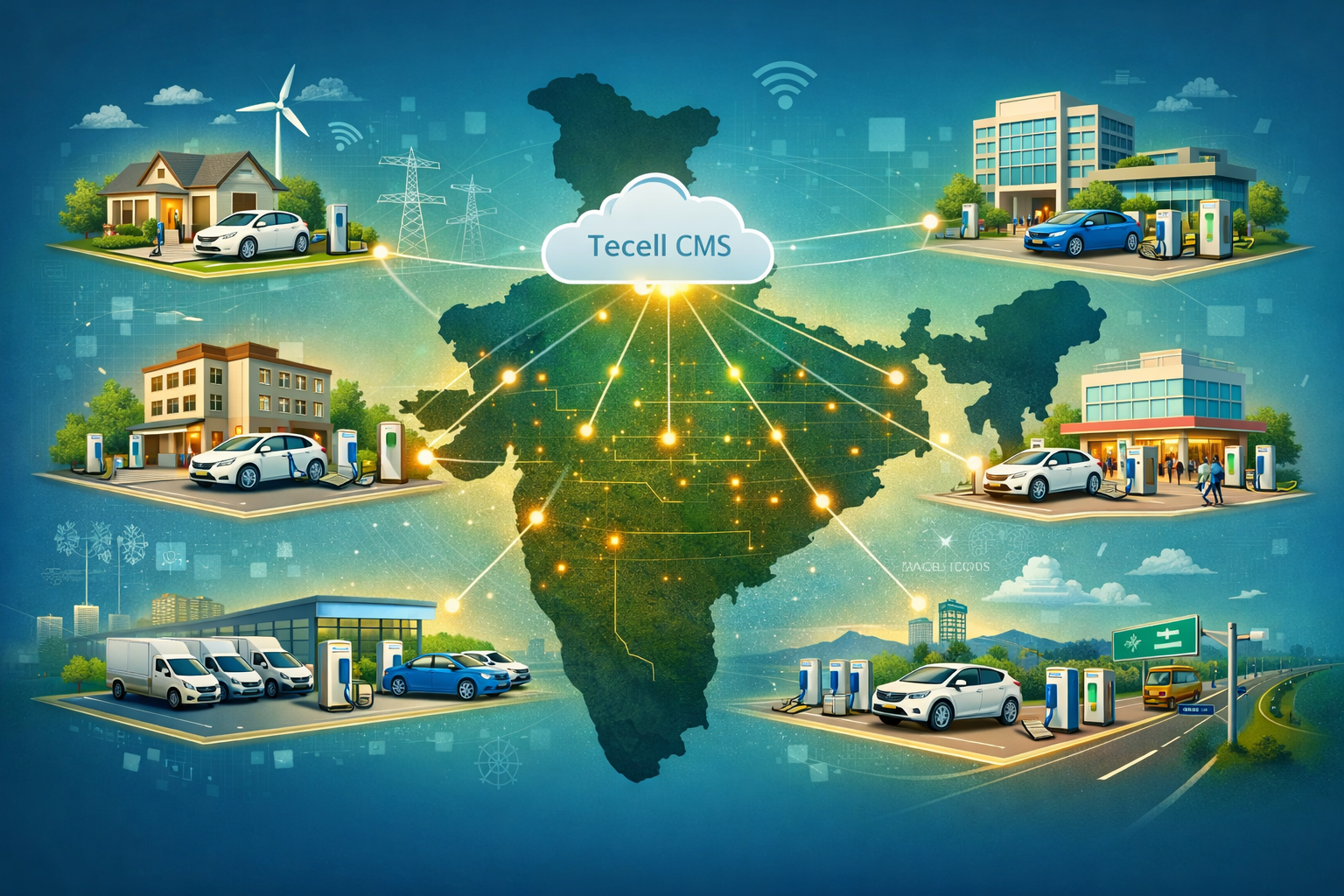
End-to-end electric vehicle charging infrastructure deployment across residential, commercial, fleet, and highway networks. Powered by Tecell's intelligent Charge Management System.
Important Disclaimer
All pricing, costs, timelines, and specifications mentioned are indicative based on 2025 market data. Actual requirements may vary significantly based on:
- Specific state/local regulations and DISCOM policies
- Site-specific conditions (electrical capacity, land availability, soil conditions)
- Contractor expertise and availability in your region
- Market fluctuations in equipment, labor, and material costs
- Grid capacity and infrastructure specific to your location
We strongly recommend obtaining detailed engineering assessments and quotations from licensed electrical contractors in your region before finalizing project plans.
Tecell's Installation Expertise
Residential Home Charging Installation
Safe, reliable, and intelligent charging solutions for independent houses and gated communities
🏠 Home Charging Essentials
Foundation of EV adoption in India, focusing on safety, simplicity, and reliability for private vehicle owners.
Grid Capacity Required
- Additional load: 7 kW (modest; most homes have 5-10 kW spare)
- Cable sizing: 2.5-4 sq mm copper wire
- Protection: 40A two-pole MCCB
- Distance: Ideal ≤50m; manageable up to 100m
Contractor Requirements
- Minimum class: Class D (house wiring contractor)
- Typical cost: Upto 2 lakh
- Timeline: 10-15 days
⚡ Smart Features with Tecell
- Safe electrical integration with existing home infrastructure (210-240V single-phase or 410-440V three-phase)
- Smart scheduling to avoid household load conflicts during peak hours
- App-based monitoring for convenience and transparency
- Centralized monitoring across multiple homes or projects
- Usage analytics to plan future infrastructure upgrades
- White-label experiences for builders and property managers
Apartment & Multi-Unit Residential Buildings
Intelligent load management solutions for shared residential environments
The Core Challenge
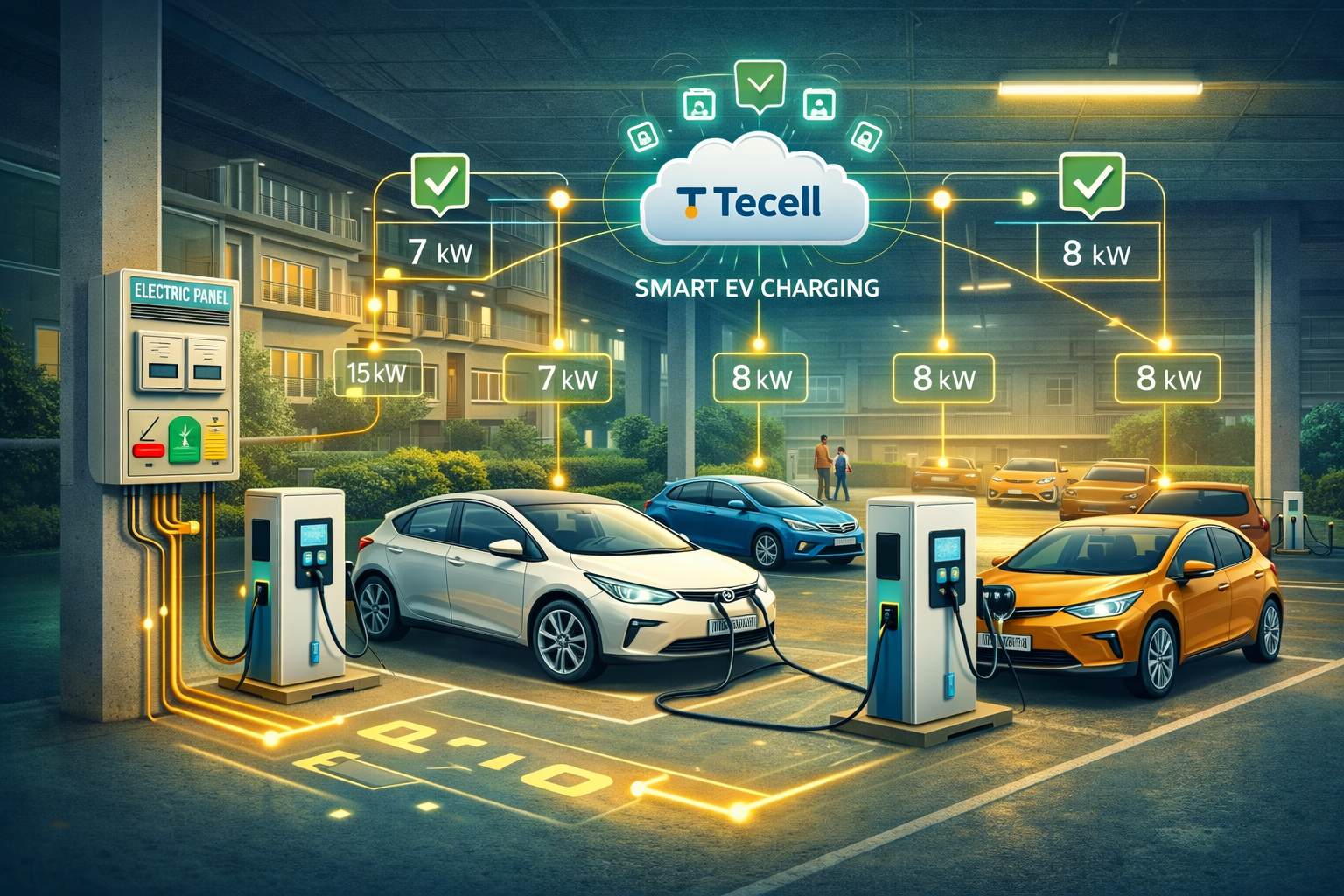
Apartments face shared electrical constraints, common parking areas, and need fair access and billing across residents. Without intelligent control, EV adoption quickly stresses building infrastructure.
🏢 Load Calculation Example
For a typical 100-unit apartment complex with 200 parking spaces:
Scenario 1 (Conservative)
- 20% of spaces with chargers = 40 × 7 kW units
- Peak simultaneous load (40% usage): 112 kW required
- Typical building load: 150-300 kW (affordable upgrade)
Scenario 2 (Smart Load Balancing via Tecell)
- Same 40 chargers, but staggered charging
- Load reduced to 40-50 kW through off-peak scheduling
- Often fits within existing transformer capacity
- Zero upgrade cost in many cases
🔧 Installation Details
Contractor Requirements
- Minimum class: Class B (multi-charger coordination)
- Typical cost: Upto 50 lakh (10 chargers + load management)
- Timeline: 60-90 days (includes RWA + DISCOM + CEIG approvals)
Tecell's Apartment Solutions
- Dynamic load balancing across multiple chargers
- Resident-level authentication and access control
- Transparent usage-based billing integration
- Real-time analytics for demand patterns
- Scalable expansion as EV adoption grows
Regional Approvals & Timelines
| Region | Approval Body | Timeline | Key Requirements |
|---|---|---|---|
| Karnataka | BESCOM | 30-60 days | No BESCOM NOC if ≤150 kW; load balancing reduces upgrades |
| Maharashtra | MSEDCL + CEIG | 60-90 days | RWA NOC within 7 days; 20% parking must be EV-ready |
| Delhi | DERC (single-window) | 7-20 days | Separate EV meter required; single-window facility |
| Telangana | TGREDCO | 45-90 days | PPP model; load capacity constraints |
| Tamil Nadu | TANGEDCO | 45-60 days | Local authority permission required first |
Commercial & Industrial Fleet Charging Installation
Software-optimized depot charging for logistics, corporate fleets, and public transport operators
🚚 Local Delivery Fleets
Last-mile logistics, field service vehicles
- Charger type: Level 2 AC (7-22 kW), overnight at depot
- Fleet ratio: 1:1 (one charger per vehicle)
Example: 50-Vehicle Fleet
- 50 × 11 kW = 550 kW total installed capacity
- Peak load (staggered): 50 × 11 × 0.5 = 275 kW
- Cable sizing: 16-35 sq mm copper (multi-run)
- Transformer: 315-500 kVA upgrade (₹2-5 lakh)
🎯 Fleet Optimization
Key Benefits
- Load management: Intelligent scheduling shifts charging to off-peak hours
- Cost reduction: 20-40% savings on utility costs
- Battery health: Track state-of-charge and degradation
- Telematics: Integration with fleet management systems
Contractor Requirements
- Class: B (30-150 kW) to A (150+ kW)
- Cost: ₹10-20 lakh (5-10 chargers + CMS)
- Timeline: 60-90 days (load study + DISCOM + CEIG)
Workplace Charging Solutions
Employee benefits and corporate sustainability initiatives
👔 Employee Benefit Model
Complimentary or subsidized charging as workplace amenity. Attracts talent and demonstrates environmental commitment.
💰 Revenue-Generating Model
Cost-recovery or profit charging for employee vehicles. Covers installation and operating costs.
🎫 Access Control
Badge integration, RFID tags, or mobile app authentication for employees and visitors.
📊 Usage Analytics
Track utilization patterns, plan expansion, and optimize charging schedules based on employee behavior.
Typical Installation Requirements
- Chargers: 5-20 units for 100-500 employee facilities
- Power: 50-200 kW additional capacity
- Cost: ₹8-25 lakh (equipment + installation + CMS)
- Timeline: 45-75 days
Public & Destination Charging
Retail, hospitality, entertainment venues, and urban public spaces
🏬 Retail & Malls
Customer amenity with revenue potential
- Typical dwell time: 1-3 hours
- Recommended: 7-22 kW AC chargers
- QR code activation for ease of use
- Dynamic pricing during peak hours
- Integration with loyalty programs
Business Impact
Increases foot traffic, extends shopping time, attracts environmentally-conscious customers, and generates incremental revenue.
🏨 Hospitality
Guest amenity and competitive differentiator
- Overnight charging for hotel guests
- Complimentary or room-charge billing
- Valet integration for managed parking
- Premium positioning for luxury hotels
Installation Specifications
- 5-15 chargers typical for 100-200 room hotels
- Cost: ₹7-20 lakh
- Timeline: 45-60 days
🎭 Entertainment & Dining
Extended dwell time opportunities
- Movie theaters: 2-3 hour sessions
- Restaurants: 1-2 hour dining experiences
- Gaming zones & entertainment centers
- Session-based or per-kWh billing
Highway Corridor Fast Charging
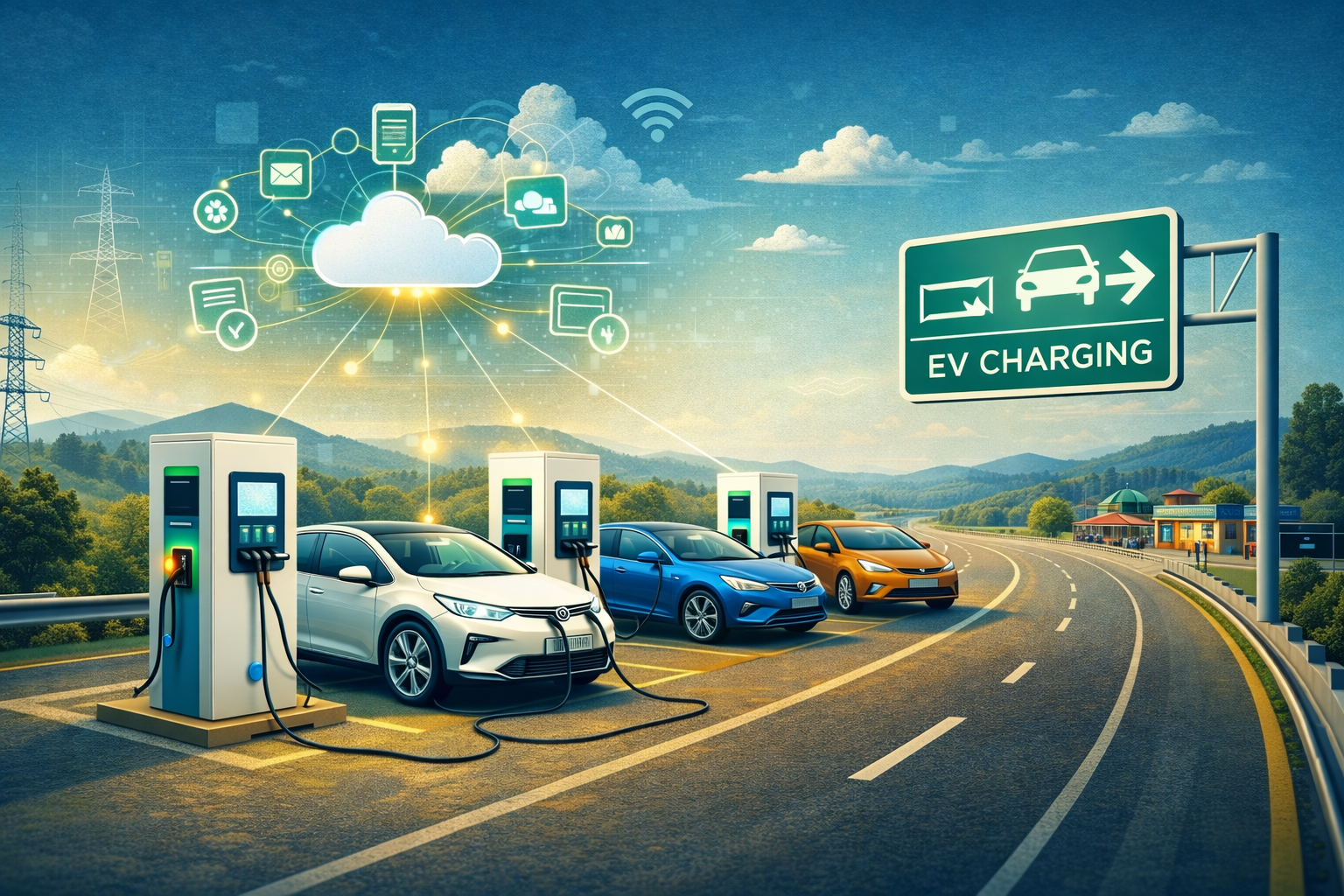
DC fast charging infrastructure for inter-city travel
🛣️ Highway Station Requirements
Charger Specifications
- Power: 50-150 kW DC fast chargers
- Charging time: 20-45 minutes for 80% charge
- Spacing: Every 80-120 km recommended
- Connector types: CCS2, CHAdeMO, GB/T
Grid Infrastructure
- HT connection (11 kV or 33 kV) required
- Transformer: 250-500 kVA for 2-4 chargers
- Grid connection cost: ₹5-15 lakh
- Total project cost: ₹40-80 lakh (2-4 chargers)
🔋 Advanced Solutions
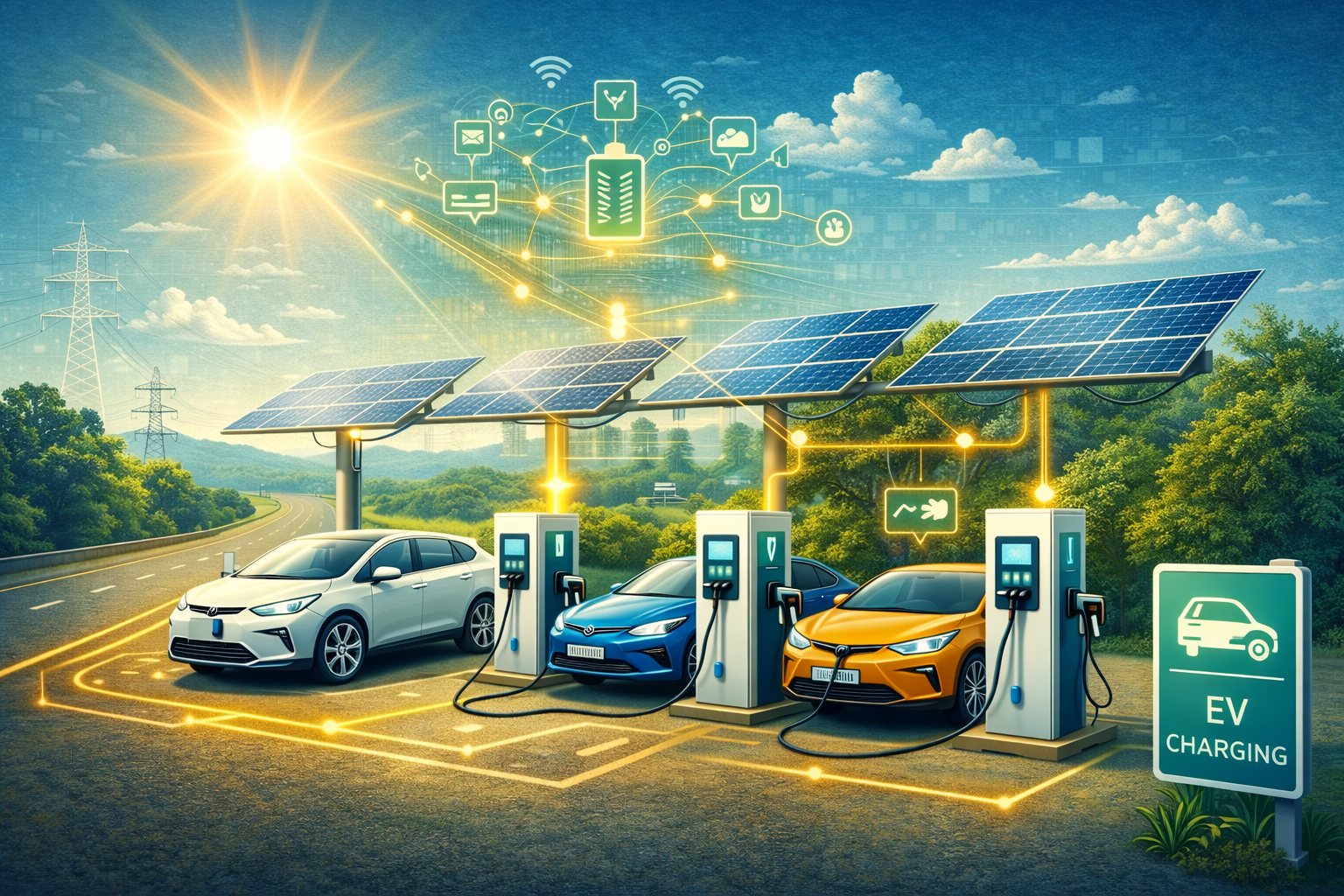
Solar + Battery Integration
- 50-100 kW rooftop solar reduces grid dependency
- Battery storage (100-200 kWh) for peak shaving
- 30-40% reduction in electricity costs
- Grid resilience during outages
Amenities & Safety
- Restrooms and refreshment facilities
- Covered charging bays
- 24/7 security and lighting
- Emergency assistance services
Timeline & Approvals
- NHAI approval: 60-120 days for highway ROW
- HT connection: 90-180 days (DISCOM dependent)
- CEIG clearance: Required for HT installations
- Fire NOC: Required for fast charging stations
- Total timeline: 6-12 months from site selection to commissioning
Technical Specifications & Standards
Industry-standard protocols and compliance requirements
🔌 OCPP Integration
Open Charge Point Protocol for remote monitoring, firmware updates, and smart charging features. Version 1.6J and 2.0.1 supported.
🌐 OCPI Roaming
Real-time session management and automated billing between networks. Seamless user experience across operators.
🛡️ ISO 27001 Certified
Robust cybersecurity protocols with 24/7 monitoring and incident response. Data protection and privacy compliance.
⚖️ Smart Load Balancing
Dynamic power distribution to prevent overloads and optimize charging speeds. Reduces grid infrastructure costs.
☀️ Renewable Integration
Optimize charging rates based on solar and wind energy availability. Reduces carbon footprint and energy costs.
🔄 V2G Ready
Vehicle-to-Grid technology for bidirectional energy flow and grid stabilization. Future-ready infrastructure.
Electrical Contractor Classification
| Class | License Type | Suitable For | Typical Projects |
|---|---|---|---|
| Class A | Unlimited electrical work | 150+ kW installations, HT connections | Highway stations, large fleet depots, industrial facilities |
| Class B | Up to 650 kW load | 30-150 kW installations, LT connections | Apartments, workplaces, retail complexes |
| Class C | Up to 150 kW load | 10-30 kW installations | Small residential societies, local businesses |
| Class D | House wiring contractor | Single charger installations | Individual homes, small offices |
Installation Process
End-to-end deployment managed by Tecell's expert team
Site Assessment
Technical feasibility study, load calculation, grid capacity analysis, and cost estimation.
Design & Engineering
Electrical layout design, charger selection, cable routing, protection system design.
Approvals & Permits
DISCOM NOC, CEIG clearance, local authority permissions, building permissions.
Installation & Testing
Civil works, electrical installation, charger mounting, testing and commissioning.
CMS Integration
Tecell CMS configuration, user onboarding, payment setup, monitoring dashboard.
Operations & Support
24/7 monitoring, predictive maintenance, remote diagnostics, continuous optimization.
Why Choose Tecell for Installation?
Comprehensive solutions beyond hardware deployment
🔧 Turnkey Solutions
Complete project management from site assessment to commissioning. Single point of accountability.
🌍 Pan-India Network
SI network spans all major states with deep understanding of local regulations and DISCOM policies.
💻 Advanced CMS Platform
Seamless Tecell CMS deployment with smart load balancing, remote monitoring, and flexible billing.
💰 Cost Optimization
Smart load balancing reduces transformer upgrades by 30%. Off-peak scheduling cuts electricity costs by 20-40%.
📈 Scalable Infrastructure
Future-ready designs that scale as EV adoption grows. Phased deployment options available.
🛠️ Predictive Maintenance
AI-driven health monitoring detects issues early. Minimizes downtime with proactive maintenance scheduling.
System Integrator Partnership Opportunity
Expand into EV charging infrastructure with Tecell's proven platform
Are you a System Integrator (SI), EPC contractor, or electrical installation firm? Join Tecell's growing partner network across India.
Partner Benefits
Advanced load management, monitoring, and billing software for competitive advantage.
Design review, load calculations, regulatory guidance from Tecell's expert team.
Direct customer inquiries routed to partner network based on geography and expertise.
Tecell CMS expertise development and best practices knowledge transfer.
Recurring SaaS revenue from deployed charger networks. Long-term partnership value.
Co-branded collateral, case studies, and customer testimonials for your business.
We Partner With
- Licensed electrical contractors (Class A, B, C with relevant EV experience)
- Civil engineering & infrastructure firms with electrical expertise
- Regional EPC companies with existing grid/utility relationships
- Renewable energy integrators (solar + BESS + charging specialists)
State-Specific Expertise
Deep understanding of regional regulations and DISCOM policies
Karnataka (BESCOM)
⏱️ Timeline: 30-60 days
No NOC required for ≤150 kW. Simplified approval process. Strong renewable energy integration support.
Maharashtra (MSEDCL)
⏱️ Timeline: 60-90 days
20% parking EV-ready mandate. CEIG clearance for >9.9 kW. RWA NOC within 7 days.
Delhi (DERC)
⏱️ Timeline: 7-20 days
Single-window facility. Separate EV meter required. Fastest approvals in India.
Telangana (TGREDCO)
⏱️ Timeline: 45-90 days
PPP model for public charging. Grid capacity planning considerations.
Tamil Nadu (TANGEDCO)
⏱️ Timeline: 45-60 days
Local authority permission required first. Strong EV policy support.
Gujarat, Rajasthan & Others
⏱️ Timeline: Varies by state
Comprehensive coverage across India. Contact us for state-specific guidance.
Frequently Asked Questions
Ready to Deploy EV Charging Infrastructure?
Connect with Tecell's expert team for site assessment, cost estimation, and turnkey installation services.
Connect With Us
For technical consultations, partnership inquiries, and project discussions