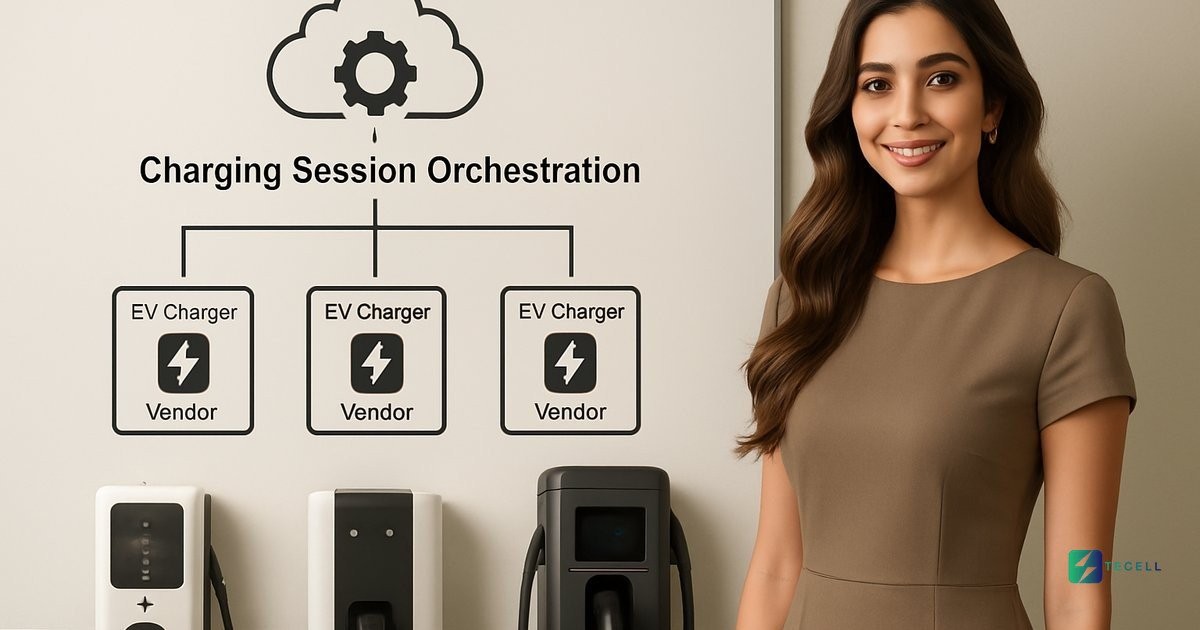
What Is a Charging Session Orchestration Layer?
A charging session orchestration layer is a system component that manages and coordinates the lifecycle of EV charging sessions across multiple charging points. It ensures that each session is handled efficiently, from initiation to completion, while maintaining synchronization across distributed networks. This layer is critical for operators managing high-concurrency environments where thousands of charging events occur simultaneously.
For example, a logistics company managing 40 vehicles with varying charging needs must ensure that each vehicle’s session is tracked, optimized, and completed without conflicts or delays. The orchestration layer handles this complexity by maintaining real-time state information and coordinating actions across all connected chargers.
Without such a system, operators risk inefficiencies like missed sessions, incorrect billing, or even safety issues due to mismanaged power flow. The orchestration layer acts as the central nervous system for modern charging infrastructure.
Why Scalability Matters in Charging Session Orchestration
Scalability in charging session orchestration refers to the ability of a system to handle increasing numbers of concurrent charging sessions without degradation in performance. As EV adoption grows, so does the number of charging points and users.
Consider a large commercial facility with 200 charging stations. Each station may support multiple vehicles, and during peak hours, hundreds of sessions could be active at once. A scalable orchestration layer must manage these sessions seamlessly, ensuring no single point becomes a bottleneck.
Traditional systems often struggle under high load because they lack distributed processing capabilities. This is where technologies like Saha-Edge come into play, enabling local control and intelligent decision-making at the edge.
How OCPP 2.0.1 Supports Charging Session Orchestration
OCPP 2.0.1, the latest version of the Open Charge Point Protocol, introduces significant improvements for session management and communication between charging stations and backend systems. It supports more granular control over charging sessions, including detailed event logging and real-time status updates.
This protocol version allows for better handling of complex scenarios such as dynamic pricing, load balancing, and multi-tenant environments. It also enables more robust error handling and recovery mechanisms, which are essential for maintaining session integrity.
For instance, when a session is interrupted due to a network issue, OCPP 2.0.1 ensures that the system can resume or restart the session correctly, minimizing disruption for the user and operator alike.
Integrating Saha-Edge for Intelligent Orchestration
Saha-Edge is an edge computing platform designed to enable intelligent local control and offline operation for EV charging infrastructure. It plays a crucial role in building a scalable charging session orchestration layer by bringing computation closer to the charging point.
By processing session data locally, Saha-Edge reduces latency and improves responsiveness. It also allows for offline operation, meaning that even if the connection to the central system is lost, charging sessions can continue to be managed effectively.
This approach is particularly beneficial in remote or low-connectivity areas where maintaining constant communication with a central server is challenging. Saha-Edge ensures that session orchestration remains reliable regardless of network conditions.
Key Features of a Scalable Charging Session Orchestration Layer
A robust orchestration layer must support several core features to function effectively in high-concurrency environments. These include session state synchronization, real-time monitoring, and automated decision-making capabilities.
State synchronization ensures that all charging points have consistent information about each session. This prevents conflicts and ensures accurate billing and reporting. Real-time monitoring allows operators to track performance and respond quickly to issues.
Automated decision-making capabilities, powered by AI and machine learning, can optimize charging schedules, predict maintenance needs, and adjust power distribution based on real-time demand. These features collectively enhance the efficiency and reliability of the charging network.
Real-World Scenario: Managing a Fleet of Electric Delivery Trucks
Imagine a delivery company operating a fleet of 100 electric trucks. Each truck requires regular charging during shifts, and the company operates charging stations at multiple depots. The challenge lies in coordinating these sessions efficiently across different locations and times.
With a scalable charging session orchestration layer, the company can monitor all sessions in real time, ensure fair access to charging resources, and optimize charging schedules to reduce peak load. This system prevents bottlenecks and ensures that each truck is charged according to its schedule.
The integration of OCPP 2.0.1 and Saha-Edge allows the company to manage this complexity without relying solely on centralized control, making the system more resilient and adaptable to changing conditions.
Benefits of Using OCPP 2.0.1 and Saha-Edge Together
Combining OCPP 2.0.1 with Saha-Edge creates a powerful foundation for scalable charging session orchestration. OCPP 2.0.1 provides the communication standards and session management features, while Saha-Edge delivers the edge computing capabilities needed for local processing and control.
This combination enables faster response times, improved reliability, and better handling of high-concurrency scenarios. It also supports offline operations, which is crucial for maintaining service availability in challenging network environments.
Operators benefit from reduced latency, enhanced security, and more granular control over their charging infrastructure. These advantages translate into improved user experience and operational efficiency.
Challenges in Implementing a Scalable Orchestration Layer
Implementing a scalable charging session orchestration layer comes with several challenges. One major challenge is ensuring consistent performance across diverse hardware and software configurations.
Another challenge involves managing data consistency and synchronization across distributed systems. With many charging points operating independently, maintaining a unified view of session states can be complex.
Additionally, integrating legacy systems with newer protocols like OCPP 2.0.1 requires careful planning and testing. Operators must balance innovation with compatibility to avoid disruptions in service.
Best Practices for Building a Robust Orchestration System
To build a robust charging session orchestration system, operators should start by defining clear requirements and performance benchmarks. This includes identifying expected session volumes, peak usage times, and desired response times.
Next, they should choose technologies that support scalability and flexibility, such as OCPP 2.0.1 and Saha-Edge. These tools provide the necessary infrastructure for handling complex scenarios and scaling as needed.
Regular testing and monitoring are also essential. Operators should simulate high-concurrency scenarios to validate system performance and identify potential bottlenecks before they impact real-world operations.
Future Trends in Charging Session Orchestration
As EV adoption continues to grow, charging session orchestration will evolve to meet new demands. Future trends include greater integration with renewable energy sources, advanced AI for predictive analytics, and enhanced interoperability between different platforms.
Operators will increasingly rely on systems that can adapt to dynamic energy markets and support vehicle-to-grid (V2G) capabilities. These advancements will require orchestration layers that are not only scalable but also intelligent and responsive.
The evolution of protocols like OCPP and platforms like Saha-Edge will play a key role in shaping these future capabilities. Staying ahead of these trends will be crucial for operators aiming to provide seamless and efficient charging experiences.
Frequently Asked Questions
- What is the role of OCPP 2.0.1 in charging session orchestration? OCPP 2.0.1 enhances session management by providing better communication standards and real-time status updates, which are essential for coordinating complex charging scenarios.
- How does Saha-Edge improve session orchestration? Saha-Edge enables local processing and control, reducing latency and supporting offline operations, which improves reliability in distributed charging networks.
- Why is scalability important for charging session orchestration? Scalability ensures that the system can handle increasing numbers of concurrent sessions without performance degradation, which is critical for large-scale deployments.
- What are the benefits of combining OCPP 2.0.1 and Saha-Edge? This combination offers faster response times, improved reliability, and better handling of high-concurrency scenarios, making it ideal for modern charging infrastructure.
- What challenges should operators consider when implementing an orchestration layer? Key challenges include ensuring data consistency, managing diverse hardware configurations, and integrating legacy systems with new protocols.
Related Reading
For more on related topics, see: Scalable OCPP Gateway for Multi-Vendor Charging Hardware.
Further reading: EV Charging Software Features | Tecell CMS (UnityCharge) – OCPP, Billing, Mobile
📣 Join our Telegram channel for EV charging technology insights and product updates.
Also find us on: LinkedIn · X · Bluesky · Mastodon · DEV.to.