Why Secure Multi-Tenant Data Isolation Matters for Charge Point Operators
Charge Point Operators (CPOs) manage complex networks of electric vehicle charging stations across multiple locations. Each site may serve different customers, partners, or internal teams. This diversity creates a need for secure multi-tenant data isolation in EV charging platforms. Without proper safeguards, sensitive information can be exposed, leading to compliance risks and operational challenges.
Secure multi-tenant data isolation ensures that each tenant—whether a fleet operator, property manager, or utility company—can access only their own data. It also allows CPOs to maintain control over their infrastructure while meeting regulatory requirements. This is especially important in markets where data privacy laws are strict.
For example, a logistics company managing 40 vehicles faces unique data needs. They require visibility into usage patterns, billing details, and driver behavior. At the same time, they must ensure that their data remains separate from other users on the same platform. This separation is made possible through secure multi-tenant architecture.
Understanding how this works helps CPOs choose platforms that protect their data and support scalable operations. It also ensures compliance with evolving standards like GDPR, HIPAA, and local charging regulations.
What Is Secure Multi-Tenant Data Isolation?
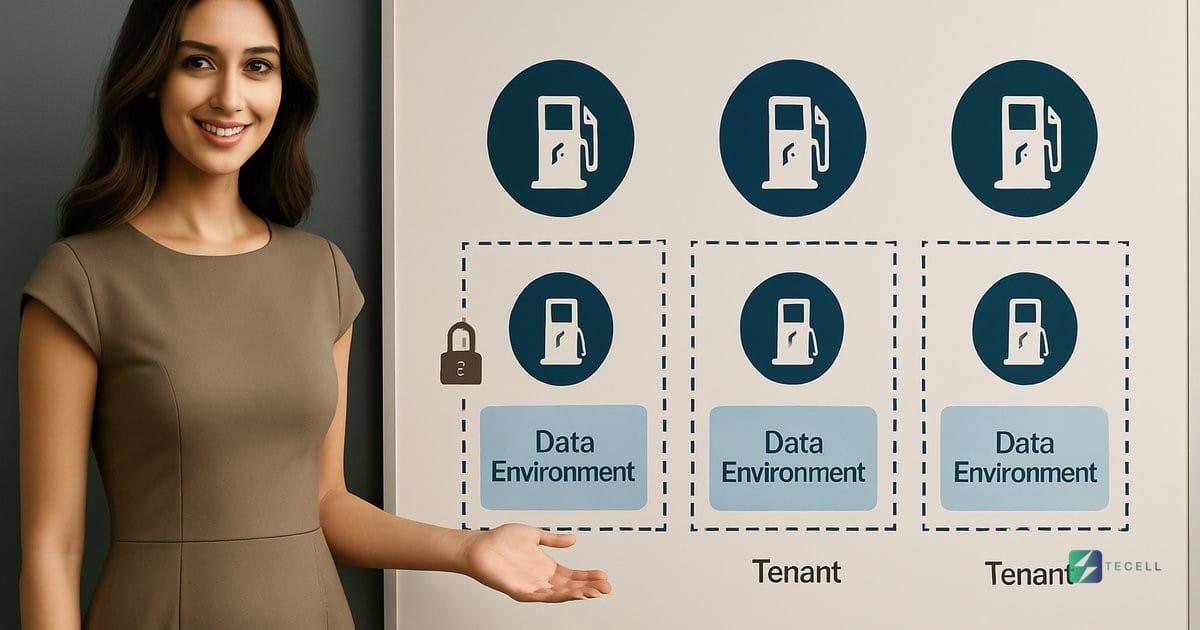
Secure multi-tenant data isolation refers to the practice of keeping data from different users or organizations completely separate within a shared system. In the context of EV charging platforms, this means that each CPO or tenant operates within their own secure environment, even when using the same software infrastructure.
This approach prevents unauthorized access to sensitive information such as customer billing records, vehicle usage logs, or operational metrics. It also ensures that one tenant’s data cannot be accessed by another, even if they share the same platform instance.
For instance, a residential property manager and a commercial fleet operator might both use the same CMS platform. However, their data must remain isolated to protect privacy and maintain operational independence. This is not just about security—it’s about enabling trust between partners and customers.
Implementing secure multi-tenant data isolation requires careful design of access controls, encryption, and data segmentation. These features must be built into the platform from the ground up, not added as an afterthought.
How Tecell’s CMS Enables Secure Multi-Tenant Data Isolation
Tecell’s Charge Management System (CMS) is built with secure multi-tenant architecture at its core. This design allows CPOs to manage multiple charging networks while maintaining strict data boundaries between tenants.
Each tenant has its own isolated workspace within the system. This includes dedicated dashboards, user roles, and reporting tools. These features ensure that no data leaks occur between different users or organizations.
For example, a CPO managing both public and private charging stations can assign different teams to each network. One team handles public charging, while another manages internal fleet charging. Both teams work independently, with no overlap in data access or visibility.
The CMS also supports role-based access control (RBAC). This means that permissions are defined per user or group, ensuring that only authorized individuals can view or modify specific data. This level of control is essential for maintaining compliance and operational integrity.
Key Benefits of Secure Multi-Tenant Data Isolation for CPOs
Secure multi-tenant data isolation offers several key benefits for Charge Point Operators. First, it enhances data privacy and compliance. Many regions have strict rules about how personal and operational data must be handled. Isolated data environments help CPOs meet these requirements more easily.
Second, it improves operational efficiency. When data is segmented, teams can focus on their specific tasks without interference from other users. This reduces confusion and speeds up decision-making processes.
Third, it supports scalability. As CPOs grow their networks, they can add new tenants without compromising existing systems. Each new tenant gets its own secure space, making expansion seamless.
Finally, it builds trust with partners and customers. When data is protected and isolated, stakeholders feel confident that their information is safe. This trust is critical for long-term business relationships.
Real-World Scenario: Fleet Charging with Secure Data Isolation
A logistics company operating a fleet of 40 electric delivery vehicles uses Tecell’s CMS to manage charging across multiple depots. Each depot has its own set of charging stations, and each driver has access to their own usage data.
The company’s IT team manages the overall system, but individual drivers and depot managers have limited access based on their roles. This setup ensures that sensitive data like billing records or driver performance metrics are only visible to authorized personnel.
When the company expands to include a new partner, they can onboard them quickly without affecting the existing data structure. The new partner gets their own isolated tenant, with full control over their data and operations.
This scenario shows how secure multi-tenant data isolation enables both security and flexibility. It allows CPOs to scale efficiently while maintaining strict data boundaries.
Compliance and Regulatory Considerations
Regulatory compliance is a major concern for CPOs, especially in Europe and North America. Standards like GDPR, HIPAA, and local charging regulations require that personal and operational data be handled carefully.
Secure multi-tenant data isolation helps CPOs meet these requirements by ensuring that data is not shared between tenants. This reduces the risk of accidental exposure and simplifies audit processes.
For example, a CPO working with healthcare providers must ensure that patient-related data is never mixed with general fleet data. Secure isolation makes this possible, even when both types of data are stored in the same system.
By choosing a platform with built-in secure multi-tenant architecture, CPOs can reduce the burden of compliance and focus on delivering reliable charging services.
Technical Implementation of Secure Multi-Tenant Data Isolation
Secure multi-tenant data isolation is not just a feature—it’s a foundational design principle. It involves several technical components working together to protect data.
First, data segmentation ensures that each tenant’s data is stored separately. This can be done through database schemas, table structures, or even separate databases. The goal is to prevent any cross-contamination of information.
Second, access controls are implemented at multiple levels. These include network-level firewalls, application-level authentication, and user-level permissions. Each layer adds an extra barrier to unauthorized access.
Third, encryption is used to protect data both in transit and at rest. This ensures that even if data is intercepted, it remains unreadable without the proper keys.
Finally, logging and monitoring systems track all access attempts and changes. This helps detect potential breaches and provides evidence for compliance audits.
Conclusion: Why Secure Multi-Tenant Data Isolation Is Essential for CPOs
Secure multi-tenant data isolation is more than a technical feature—it’s a strategic necessity for Charge Point Operators. It enables them to scale efficiently, comply with regulations, and build trust with partners and customers.
With Tecell’s CMS, CPOs can manage complex charging networks while maintaining strict data boundaries. This approach supports both operational independence and regulatory compliance, making it ideal for modern EV infrastructure.
As the EV charging landscape continues to evolve, platforms that prioritize secure multi-tenant data isolation will stand out as leaders in the industry. They offer the reliability and security that CPOs need to succeed.
Related Reading
For more on related topics, see: EV Charging Software & Management Platforms | Tecell.
Further reading: Privacy Policy – Tecell CMS
📣 Join our Telegram channel for EV charging technology insights and product updates.
Also find us on: LinkedIn · X · Bluesky · Mastodon · DEV.to.