
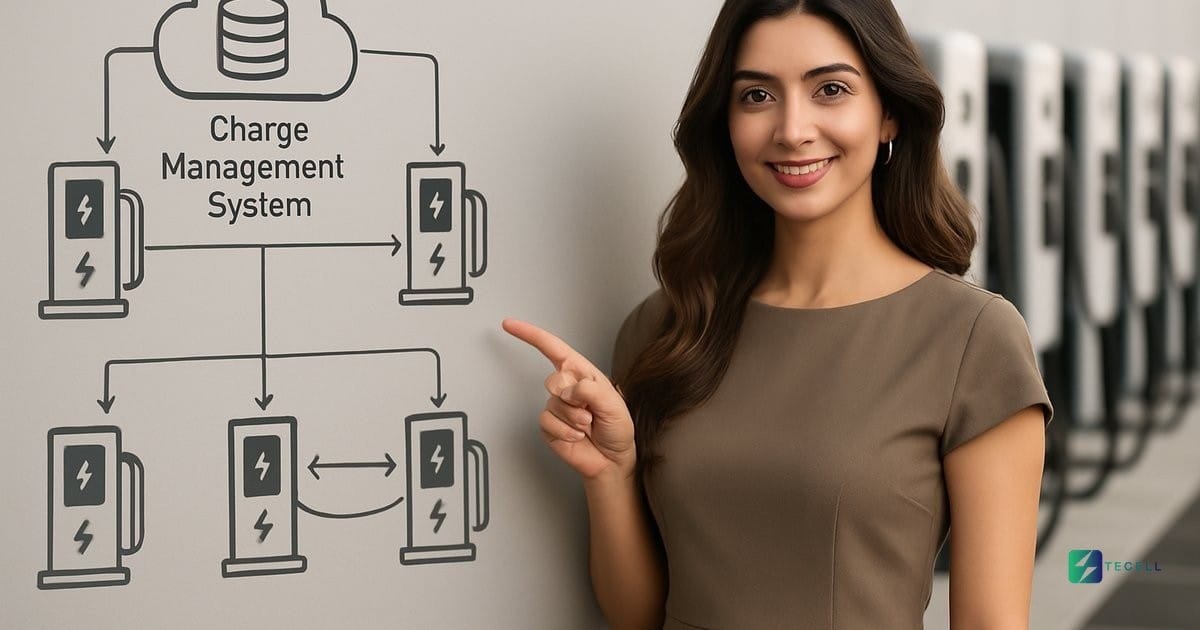
Yes, UnityCharge’s Charging Management System can enforce real-time dynamic load balancing across 100+ charging stations in a university campus deployment using OCPP 2.0.1 and Saha-Edge’s edge-AI capabilities, even without cloud connectivity.
How it works in practice
UnityCharge leverages OCPP 2.0.1’s advanced messaging capabilities to communicate load limits and charging preferences directly to individual chargers. Saha-Edge’s edge computing platform processes these commands locally, enabling immediate response to changing power demands. This setup allows the system to dynamically adjust charging rates across multiple stations based on real-time grid conditions or predefined capacity thresholds.
The system uses AI-powered algorithms to predict and respond to fluctuations in energy demand. For instance, if a sudden spike in charging activity occurs, the edge-AI can reduce power to non-critical stations while maintaining priority for high-priority ones. This ensures optimal distribution of available power without requiring constant cloud communication.
For a university campus, this means that during peak hours, the system can automatically shift charging loads to off-peak times or distribute power more evenly across all stations, preventing overloads and maintaining service reliability.
What this means for campus deployments
In a large-scale deployment like a university campus, this capability ensures that charging infrastructure remains responsive and efficient even under high demand. It allows facility managers to maintain consistent service levels without relying on continuous internet connectivity or cloud-based decision-making.
The solution supports both centralized and decentralized control models. Campus administrators can define policies that apply across all stations, such as limiting total power draw or prioritizing certain types of vehicles. These policies are enforced locally by Saha-Edge, making the system resilient to network outages.
This approach also simplifies compliance with local grid regulations. By managing load distribution at the edge, the system can automatically adapt to utility requirements or demand response programs without manual intervention, reducing operational overhead for campus facilities teams.
Related Reading
For more on related topics, see: Edge-Cloud Co-Design for Smart Charging: Reducing Latency and Improving Load Balancing.
Further reading: EV Charging Software Features | Tecell CMS (UnityCharge) – OCPP, Billing, Mobile
📣 Join our Telegram channel for EV charging technology insights and product updates.
Also find us on: LinkedIn · X · Bluesky · Mastodon · DEV.to.