
Key takeaway: When a CCS2 charging gun is stuck in the car, the charger is not necessarily the problem. In CCS2 vehicles, the locking mechanism is generally part of the vehicle charging inlet, and the vehicle controls when that connector can be released.
That distinction matters in India, where drivers and charging-site staff often describe every stuck-connector event as a “charger gun stuck” or “charger problem.”
You finish charging your electric car, stop the session, and reach for the charging gun.
Nothing happens.
You press the release button. You unlock the car. You try again.
The charging gun is still locked into the vehicle.
The first reaction is usually: “The charger is faulty.”
In many cases, that is not where the problem is.
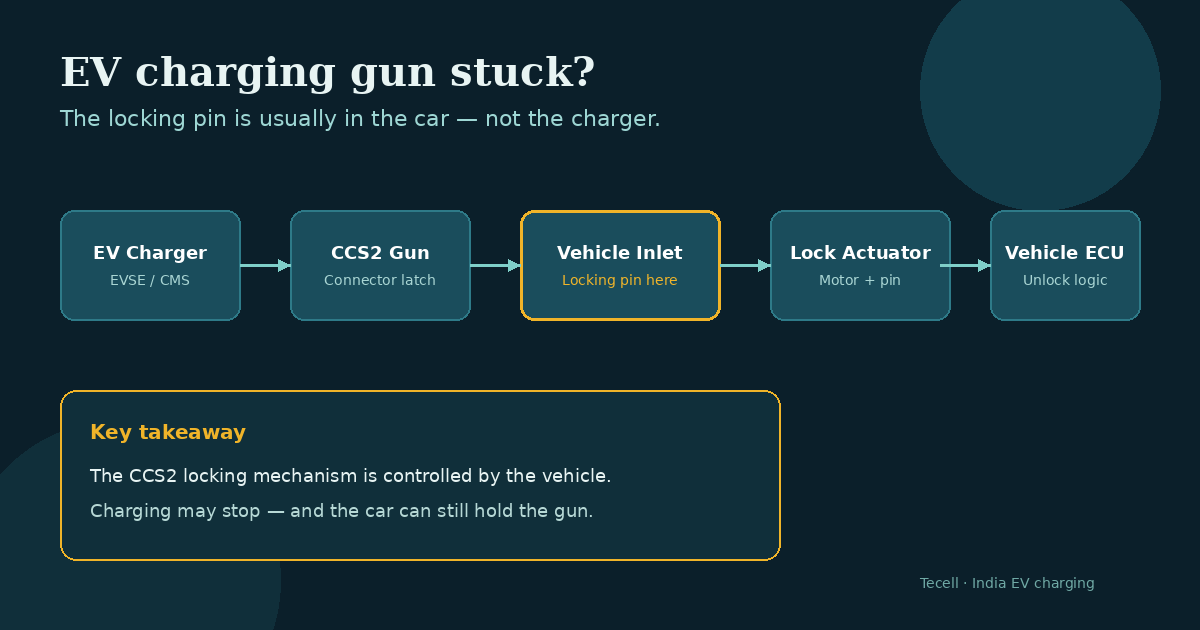
For CCS2 vehicles, the connector locking mechanism sits in the vehicle charging inlet. A motorised locking actuator drives a locking pin that prevents the connector from being removed while charging — or while the vehicle still considers the connection active. The control logic for this mechanism is on the vehicle side. (TE Connectivity)
A public charger can successfully stop delivering power while the car’s locking actuator fails to retract.
To the driver, the symptom looks like a charger problem: “The charger gun won’t come out.”
Technically, the problem may actually be: “The vehicle has not released the charging connector.”
What actually locks the charging gun?
A CCS2 charging system involves several components:
Charging station → charging cable → CCS2 connector → vehicle charging inlet → vehicle control electronics
The connector has a normal mechanical latch, but the vehicle inlet also has a locking actuator. During charging, the vehicle can extend a locking pin into the connector mechanism so the driver cannot pull the connector out while potentially dangerous electrical power is present.
Texas Instruments’ EV charging reference design describes the CCS locking mechanism as a motor-driven pin in the charging inlet, with feedback to indicate whether the lock is engaged. (Texas Instruments) TE Connectivity, which manufactures automotive charging-inlet actuators, similarly describes an actuator at the vehicle inlet that drives a locking pin and prevents removal during charging.
A simple analogy
Think of the charging gun as a door handle.
- The charger gun’s button is the handle.
- The vehicle’s locking pin is the deadbolt.
Pressing the handle does nothing if the vehicle has not withdrawn the deadbolt. That is why repeatedly pressing the release button on the charging gun may not solve the problem.
Three different things that can go wrong
A “charging gun stuck” event should not automatically be classified as a charger hardware fault. There are at least three layers:
- Charger / EVSE problem — the station has not properly terminated the session, has lost communication, or has another EVSE-side fault.
- Communication / session problem — charger and vehicle have stopped communicating correctly, leaving one side waiting for a state change.
- Vehicle locking problem — charging has actually stopped, but the vehicle’s charging-inlet actuator has not released the connector.
The third situation is the one most often misunderstood.
Mahindra’s newer EV documentation is useful here because it explicitly distinguishes a “Gun Stuck” condition from other charging problems and provides an in-car Charge Port Disconnect Switch plus a manual override. Its XEV 9e documentation also includes a separate message indicating that a charge gun was not released due to an EVSE issue. (Mahindra Electric SUVs)
So the right question is not “Is the charger faulty?” It is: Which side has failed to complete the unlock sequence?
Why this happens more often than drivers expect
A vehicle may keep its connector locked because:
- the charging session has not completely terminated;
- the vehicle has not received the expected charging-state transition;
- the vehicle software has not commanded the lock actuator to retract;
- the 12V electrical system is weak or had a transient fault;
- the locking actuator or its feedback sensor has malfunctioned;
- the connector is under mechanical load;
- the connector was manipulated before the vehicle finished its shutdown sequence.
There is also an important timing issue. Some vehicles deliberately wait several seconds after charging stops before releasing the gun.
For example, Tata manuals specify approximately 15–20 seconds for some models after DC charging power is switched off. Kia and Hyundai also describe automatic unlocking after charging completion on several models.
Charging stopped ≠ connector immediately unlocked.
What to do right now
- Stop the session on the charger screen, app, or RFID — do not yank the gun.
- Confirm charging has stopped on both the charger display and the car’s indicator.
- Unlock the car — on many EVs this is part of normal release.
- Use the vehicle’s release control (dashboard button, charge-port switch, or infotainment lock mode).
- Wait 15–20 seconds if your OEM specifies an unlock delay.
- Never force the connector — use the model-specific emergency cable/lever only after current has stopped.
The Tata EV situation: why drivers get confused
Tata is a particularly interesting example because its manuals have used different approaches across models and model years.
Several Tata EV manuals provide a charging-gun unlock switch on the vehicle.
- Tiago EV — switch off the AC supply and press the vehicle’s charging-gun unlock switch; DC unlocking can take around 15–20 seconds.
- Tigor EV — vehicle-side unlock switch; wait approximately 15–20 seconds for fast-charging unlock. (Tata Motors EV)
- Nexon EV — if the gun remains stuck after pressing the fascia switch five times, a mechanical override lever is documented (July 2025 manual). Tata warns this must only be used after confirming current delivery has stopped. (Nexon EV Owner’s Manual)
- Curvv EV — emergency charging-gun unlocking cable inside the bonnet area. (Curvv EV Owner’s Manual)
- Harrier.ev — vehicle-side unlock switch and an emergency cable accessible from the luggage compartment.
There is an important complication: some Tata manuals say that in an unforeseen stuck-gun situation no user mechanical override is available, while later manuals describe a mechanical override. For example, published Punch EV manuals differ by version — an earlier edition says no user override; a later 2025 version documents an override lever. (Punch EV Owner’s Manual)
EV owners should not rely on advice from another Tata model or an older YouTube video. The correct emergency procedure depends on the exact model year and vehicle version.
India EV charging-gun release guide by brand and model
The following table is based primarily on OEM manuals and support material for Indian-market vehicles. Procedures can change by model year, variant, and software version. Treat it as a reference guide, not a universal repair procedure.
| Brand / model | Normal connector release | Emergency / stuck-gun approach |
|---|---|---|
| Tata Nexon EV | Vehicle fascia charging-gun unlock switch; DC charging has a delay before unlock | Mechanical override lever in the July 2025 manual; use only after confirming charging current has stopped |
| Tata Punch EV | Vehicle charging-gun unlock switch for AC; DC can auto-unlock after charging stops | Manuals differ by version: earlier says no user override; later 2025 manual documents an override lever |
| Tata Tiago EV | Dashboard charging-gun unlock switch; 15–20 sec can be required for DC | Published guidance directs owners to service personnel for a gun that remains stuck; check model-year docs before any override |
| Tata Tigor EV | Dashboard charging-gun unlock switch | Manual directs owners to authorised service for certain stuck/emergency situations; referenced version states no user mechanical override |
| Tata Curvv EV | Vehicle unlock switch; DC gun unlocks after charger supply is switched off | Emergency cable from bonnet; emergency charging shutdown may leave the gun locked and require service |
| Tata Harrier.ev | Fascia-panel unlock switch; DC can auto-release after shutdown | Emergency cable in luggage compartment; PEPS ignition ON/OFF if the gun remains stuck |
| MG ZS EV | Vehicle electronic locking; unlock the car to release connector | Emergency release cable under the bonnet; Indian owners have reported real stuck-gun incidents needing manual release |
| Hyundai Kona Electric | Vehicle-controlled connector lock; unlocking the car releases the connector per lock mode | Emergency cable under bonnet when electrical power/wiring prevents normal release |
| Hyundai IONIQ 5 | Unlock a vehicle door, then press the connector latch | Emergency cable in the right side of the liftgate/cargo area |
| Hyundai Creta Electric | Configurable lock mode: Always / While Charging / Do Not Lock; DC locks during charging | Emergency cable under bonnet for battery discharge or electrical failure |
| Kia EV6 | Infotainment: Always Lock / Lock While Charging / Do Not Lock | Emergency release cable when the connector will not detach |
| Kia Carens Clavis EV | Vehicle lock via charging connector locking mode | Emergency lift cable in the motor compartment if normal release fails |
| BYD ATTO 3 | Charge-port electric lock; unlock via key/door/central locking depending on setting | Emergency cable under bonnet; connector can re-lock after ~30 seconds if not removed |
| BYD SEAL | Vehicle charge-port anti-theft locking system | Emergency cable in right side of boot |
| Citroën ë-C3 | Unlock vehicle for normal release; for DC, switch off EVSE before removing connector | Emergency manual release under front bonnet; do not force a locked connector |
| Volvo XC40 Recharge | Release button beside charging socket or centre display | Lock/unlock sequence and emergency handle in boot; never use emergency release while charging |
| Porsche Taycan | Vehicle-managed connector release | Emergency release between the door and fender |
Real-world Tata and MG examples
This is not merely theoretical.
An MG ZS EV owner in India reported nearly 100 DC charging sessions before encountering cases where the gun remained stuck. In one severe incident, the connector stayed stuck for almost two hours despite lock/unlock cycles, restarting the car, and using the manual release — eventually resolved after 12V-system intervention. This is an owner report, not an OEM failure-rate statistic, but it shows how easily a vehicle-side lock problem is read as a charger failure. (Team-BHP)
There are also owner reports of stuck-gun incidents on Tata Nexon EVs, including cases where owners used the vehicle-side mechanical release. (Team-BHP forum)
These reports demonstrate the symptom and recovery problem, not a statistically measured failure rate for every vehicle of a given model.
Why the charger screen can make this more confusing
- Vehicle is charging
- Driver stops the charging session
- Charger stops current
- Vehicle should retract its locking pin
- Vehicle fails to retract it
- Driver sees: “Gun stuck”
From the customer’s perspective, the charger is showing an error. But the physical gun may be stuck because the vehicle’s lock actuator is still engaged.
A good charging support system should distinguish between:
- Charging session active
- Charging stopped
- Connector physically inserted
- Vehicle lock engaged / released
- EVSE fault
- Communication fault
— rather than reporting every problem simply as “Charger gun stuck.”
How an EV driver should troubleshoot a stuck charging gun
Step 1 — Stop the charging session normally
Use the charger screen, charging app, or RFID procedure specified by the operator. Do not immediately pull the connector.
Step 2 — Confirm that charging has actually stopped
Check both the charger display/status and the vehicle’s charging indicator. Some vehicles deliberately take several seconds before unlocking.
Step 3 — Unlock the car
On many EVs, unlocking the vehicle is part of the connector-release procedure. Hyundai, Kia, Volvo, BYD, and MG all document vehicle unlocking as part of normal release on various models.
Step 4 — Use the vehicle’s charging-gun release control
Depending on the vehicle, this may be a dashboard button, charge-port button, infotainment command, door unlock button, or charging-port release switch.
Step 5 — Wait for the vehicle’s unlock delay
Do not assume the connector should release instantly. OEM manuals include approximately 15–20 seconds on some Tata vehicles; other models have their own timing rules.
Step 6 — Never yank the charging gun
Tata explicitly warns against pulling a locked connector with excessive force. Hyundai, Kia, Citroën, and Mahindra similarly warn against forcibly disconnecting a locked connector.
A forced removal can damage the CCS2 inlet, locking actuator, connector latch, wiring, and communication pins. A relatively small lock problem can become a much more expensive charging-port repair.
Step 7 — Use the manufacturer’s emergency release only when charging is stopped
Many modern EVs have an emergency cable or mechanical override — for example Tata Nexon EV / Curvv EV / Harrier.ev, MG ZS EV, Hyundai IONIQ 5 / Creta Electric, Kia EV6, BYD ATTO 3 / SEAL, and Volvo XC40 Recharge. The exact location and procedure are model-specific.
Do not use the emergency release while the car is still charging
A manual emergency release is designed for failure of the normal locking mechanism. It is not a substitute for stopping an active high-power charging session.
Volvo specifically warns that its emergency release must not be used while charging is in progress. Tata likewise says its Nexon EV mechanical lever should only be used after confirming that current delivery from the charger has stopped. (Volvo Cars)
The safest principle:
Stop charging first. Release second. Remove the connector third.
What should a charging-network operator do?
When a customer calls and says “The gun is stuck,” the first response should not automatically be “The charger is faulty.”
A better diagnostic workflow:
- Has the charging session stopped?
- Is current actually flowing?
- Does the charger report an EVSE fault?
- Does the vehicle show a charging/connector error?
- Has the vehicle been unlocked?
- Does the vehicle have a charging-gun release button?
- Is the vehicle lock actuator still engaged?
- Does the vehicle manual specify an emergency release?
This can dramatically reduce unnecessary charger replacements and incorrect CPO escalation.
Why this matters for India’s EV ecosystem
India’s EV charging network is expanding rapidly, but the user experience is still often built around a simple mental model: “I plug the gun into the charger and the charger controls everything.”
That’s not how modern EV charging works. The session is a conversation between vehicle + BMS + charging electronics + communication system + EVSE + backend/CMS. The connector-lock mechanism is part of that system.
A failed unlock sequence can therefore occur even after the charger has stopped delivering energy. On a highway charge, a driver stranded with a gun still attached cannot simply drive away — what looks like a minor software or actuator issue becomes a major journey disruption.
“Gun stuck” should not be treated as a single fault
The phrase “charging gun stuck” is too vague. A better technical classification:
- Type A — EVSE-side failure: the charger has not terminated the session correctly.
- Type B — Communication / session-state failure: charger and car disagree about session state.
- Type C — Vehicle lock actuator failure: charging has stopped but the vehicle hasn’t released the connector.
- Type D — Mechanical connector problem: gun, latch, inlet, or locking mechanism physically damaged or contaminated.
- Type E — 12V / electrical failure: the vehicle cannot operate the lock actuator because its low-voltage system is unavailable or unstable.
This classification makes EV support faster and more accurate.
What EV drivers should remember
The next time a charging gun refuses to come out, don’t immediately blame the charger.
- The CCS2 locking mechanism is largely a vehicle-side function.
- The car may still be holding the connector even though the charger has stopped.
- Unlocking the vehicle may be part of the normal release sequence.
- Some cars have a dashboard release button; some have an emergency mechanical cable.
- The exact procedure depends on the model and model year.
And most importantly: never force a locked charging connector. A few extra seconds and the correct vehicle-side procedure can prevent damage to both the car and the charging equipment.
Tecell builds EV charging infrastructure and software for India’s growing charging networks. Clearer session diagnostics — including connector-lock state — help drivers and operators resolve “gun stuck” events without unnecessary charger blame.