
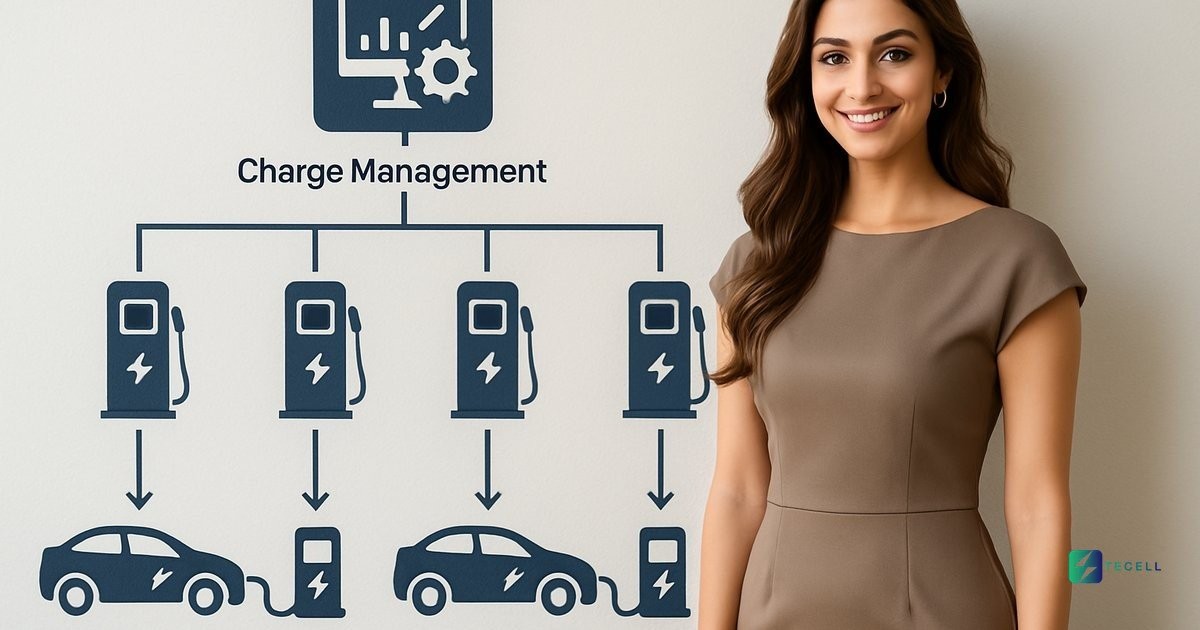
Understanding Real-Time Cross-Network Load Balancing in EV Charging
Real-time cross-network load balancing represents a critical capability for modern EV charging infrastructure. It allows operators to manage power distribution across multiple charging sites without relying on centralized cloud systems. This approach is especially valuable in environments where network connectivity is inconsistent or where rapid response to changing conditions is essential.
For a logistics company managing 40 electric vehicles, this means avoiding overloading local power grids while ensuring that all vehicles can charge efficiently. The challenge lies in coordinating power usage across different charging networks, protocols, and physical locations—without a central server to orchestrate everything.
This is where Saha-Edge comes into play. It introduces localized intelligence that enables real-time coordination of charging loads, even when offline or with limited connectivity. The system operates using edge computing principles, bringing processing power closer to the charging point.
By leveraging local AI and predictive algorithms, Saha-Edge ensures that charging operations remain stable and efficient, regardless of network conditions. This capability is particularly important for fleet operators, commercial facilities, and utility-scale deployments.
What Is Saha-Edge and How Does It Work?
Saha-Edge is Tecell’s edge computing platform designed to bring intelligent control directly to EV charging stations. Unlike traditional systems that depend on cloud-based management, Saha-Edge processes data locally, enabling faster decision-making and reducing latency.
The platform integrates with various charging protocols, including OCPP 1.6 and 2.0.1, and supports interoperability through OCPI. This means it can work seamlessly with different charging networks and devices, regardless of their origin or manufacturer.
At its core, Saha-Edge uses AI-driven automation to monitor and adjust charging behavior in real time. It evaluates factors like available power, demand forecasts, and device status to optimize performance. This local intelligence ensures that even if the network connection drops, the system continues to function effectively.
For example, a large commercial complex with multiple charging stations can use Saha-Edge to balance load across all units, preventing any single point from drawing too much power. This not only protects the grid but also improves the user experience by maintaining consistent charging speeds.
Key Features of Saha-Edge for Load Balancing
Saha-Edge’s architecture is built around three main pillars: local control, energy optimization, and integration with on-site systems. These features work together to enable effective load balancing without cloud dependency.
Local control means that each charging station can make decisions independently based on its own data and constraints. This reduces reliance on external systems and increases resilience. For instance, if one station detects a power surge, it can immediately reduce its output to protect the system.
Energy optimization involves using predictive models to anticipate demand and adjust charging accordingly. This helps operators avoid peak usage times and reduce strain on the electrical grid. It also allows for better integration with renewable energy sources, such as solar panels or battery storage systems.
Integration with on-site devices and energy systems ensures that Saha-Edge can respond to real-time changes in power availability. Whether it’s a smart meter, a battery system, or a building management system, the platform can communicate with these components to maintain optimal performance.
These capabilities are especially useful in scenarios where multiple charging networks operate under a single facility. Saha-Edge allows them to coordinate their operations, ensuring that no single network monopolizes power resources.
How Saha-Edge Enables Multi-Protocol Charging Site Coordination
Multi-protocol charging sites present unique challenges for operators. Different charging stations may use varying communication standards, making it difficult to maintain consistent control and monitoring. Saha-Edge addresses this by supporting multiple protocols natively.
OCPP (Open Charge Point Protocol) and OCPI (Open Charge Point Interface) are two widely adopted standards in the EV charging industry. Saha-Edge supports both, allowing operators to connect with a broad range of charging infrastructure and service providers.
This multi-protocol support enables seamless coordination across different networks. For example, a charging site might host both Tesla Superchargers and standard CCS connectors. Saha-Edge ensures that all these devices can be managed uniformly, even though they follow different communication rules.
By handling protocol differences at the edge, Saha-Edge eliminates the need for complex middleware or translation layers. This simplifies deployment and reduces potential points of failure in the system.
Benefits of Localized Power Coordination Without Cloud Dependency
One of the most significant advantages of Saha-Edge is its ability to operate effectively without constant cloud connectivity. This is crucial in remote or low-connectivity environments where traditional cloud-based solutions may not be feasible.
Localized coordination also improves response times. When a charging station needs to adjust its power draw, it can do so instantly rather than waiting for instructions from a distant server. This responsiveness is essential for maintaining system stability and user satisfaction.
Additionally, local processing enhances security. Sensitive data about charging behavior and power usage remains within the facility, reducing exposure to external threats. This is particularly important for enterprise and utility-scale deployments where data privacy is a concern.
Operators benefit from reduced operational costs as well. Since Saha-Edge minimizes reliance on cloud infrastructure, there are fewer recurring fees associated with data transmission and processing. This makes it a cost-effective solution for large-scale deployments.
Use Case: Fleet Operator Managing 40 Electric Vehicles
A logistics company managing 40 electric vehicles faces a complex challenge in terms of charging infrastructure. Each vehicle requires regular charging, but the company must also ensure that the charging process doesn’t overload the local power grid or disrupt other operations.
With Saha-Edge, the company can deploy a network of charging stations that coordinate their power usage automatically. The system monitors each station’s load and adjusts charging speeds to prevent overdraw. If one station is fully charged, it can reduce its power consumption to allow others to charge faster.
This kind of coordination is especially useful during peak hours when electricity demand is high. Saha-Edge can shift charging schedules to off-peak times, reducing costs and avoiding strain on the grid. It also ensures that vehicles are always ready for their next trip, even under varying conditions.
The result is a more efficient and reliable charging system that supports the company’s operations without requiring constant oversight or manual intervention.
Comparing Saha-Edge with Traditional Cloud-Based Systems
Traditional cloud-based charging management systems rely heavily on network connectivity and centralized processing. While they offer centralized control, they can be vulnerable to latency, outages, and security risks.
Saha-Edge takes a different approach by placing intelligence at the edge. This means that decisions are made locally, reducing the need for constant communication with a central server. It also makes the system more resilient to network disruptions.
For example, if a cloud-based system experiences a temporary outage, charging operations may halt or become unpredictable. With Saha-Edge, charging continues based on pre-defined rules and local data, ensuring minimal disruption to users.
Moreover, Saha-Edge’s local processing capabilities allow for more granular control. Operators can fine-tune charging behavior at each station, adapting to specific site conditions and user needs. This level of customization is harder to achieve with centralized systems.
Future Implications for EV Charging Infrastructure
As EV adoption grows, the demand for scalable and intelligent charging infrastructure will increase. Saha-Edge’s approach to localized control and real-time coordination positions it well for future developments in the industry.
With the rise of vehicle-to-grid (V2G) technologies and smart city initiatives, the ability to manage power flow dynamically becomes even more critical. Saha-Edge’s edge computing framework supports these emerging trends by enabling flexible, responsive systems.
Its multi-protocol support also ensures compatibility with evolving standards and technologies. As new charging protocols emerge, Saha-Edge can adapt quickly, maintaining its effectiveness in diverse environments.
Ultimately, Saha-Edge helps operators prepare for a future where charging infrastructure must be both intelligent and autonomous. It empowers them to build systems that can operate independently while still integrating with larger networks and services.
Related Reading
For more on related topics, see: Edge-Cloud Co-Design for Smart Charging: Reducing Latency and Improving Load Balancing.
Further reading: EV Charging Energy Management | OCPP Smart Charging CMS | Tecell India
📣 Join our Telegram channel for EV charging technology insights and product updates.
Also find us on: LinkedIn · X · Bluesky · Mastodon · DEV.to.