
Understanding OCPP 1.6 vs OCPP 2.0.1 in Mixed-Fleet Last-Mile Charging
When managing last-mile delivery charging networks, operators often face the challenge of balancing diverse vehicle types and power demands. The choice between OCPP 1.6 and OCPP 2.0.1 becomes critical for real-time dynamic power scheduling. This post explores how each protocol handles mixed fleets without relying on cloud connectivity, focusing on practical implementation strategies using Tecell’s ChargeSphere and Saha-Edge platforms.
What Is Mixed-Fleet Last-Mile Charging?
Mixed-fleet last-mile charging refers to networks serving a variety of electric vehicles with different charging capabilities, power requirements, and operational profiles. These networks often include delivery vans, cargo bikes, and light trucks, each with unique charging behaviors and constraints.
For example, a logistics company managing 40 vehicles faces challenges in optimizing charging schedules across different vehicle types. Some vehicles may require fast DC charging, while others operate on AC charging with lower power draw. This diversity complicates real-time scheduling and energy management.
Effective protocols must support dynamic adjustments to power allocation, ensuring that all vehicles are charged efficiently without overloading the local grid or causing operational delays.
OCPP 1.6 Limitations in Dynamic Power Scheduling
OCPP 1.6, while widely adopted, has inherent limitations when it comes to handling complex, real-time scheduling in mixed-fleet environments. Its architecture is more rigid and less flexible in adapting to dynamic changes in power demand.
For instance, in a scenario where a fleet of delivery vehicles arrives simultaneously, OCPP 1.6 may struggle to adjust power distribution in real time. The protocol’s message handling and communication frequency are not optimized for rapid, granular adjustments.
This can lead to inefficiencies such as underutilization of available power or unnecessary delays in charging. Operators often find themselves relying on manual interventions or external systems to manage these situations.
These constraints become more pronounced in environments without cloud connectivity, where local decision-making must be self-contained and responsive.
OCPP 2.0.1 Advantages for Real-Time Power Management
OCPP 2.0.1 introduces significant improvements over its predecessor, particularly in dynamic power scheduling and communication efficiency. It supports more granular control over charging sessions and better integration with local energy systems.
One key enhancement is the ability to send and receive detailed power consumption data in real time. This allows for more precise load balancing and better coordination between multiple charging points.
For example, in a mixed-fleet setup, OCPP 2.0.1 can dynamically adjust the power output of each charger based on the vehicle’s current charging needs and the overall network load. This flexibility is essential for maintaining operational efficiency.
Additionally, OCPP 2.0.1 supports enhanced messaging protocols that reduce latency and improve responsiveness. These features are particularly valuable in environments where cloud connectivity is unreliable or unavailable.
How ChargeSphere Enhances OCPP 2.0.1 Capabilities
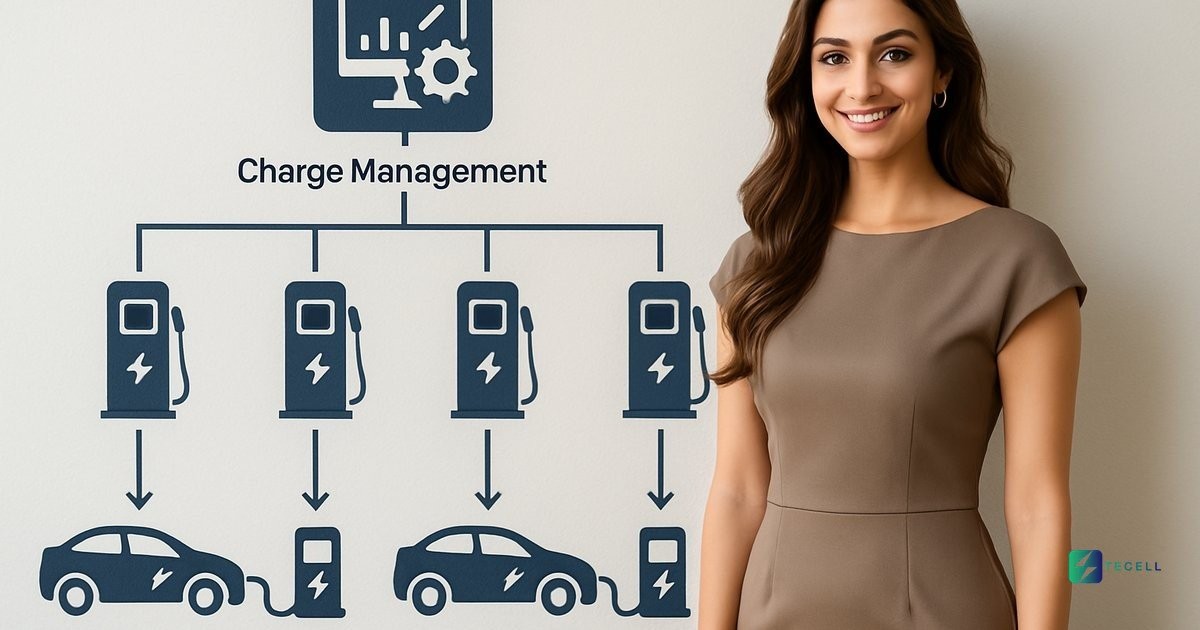
Tecell’s ChargeSphere platform amplifies the strengths of OCPP 2.0.1 by providing a centralized management layer that simplifies complex operations. It enables operators to define and enforce charging policies across diverse vehicle fleets.
ChargeSphere allows for the creation of custom charging profiles that adapt to vehicle-specific requirements. For instance, it can prioritize charging for high-priority vehicles or schedule charging during off-peak hours to reduce energy costs.
The platform also supports offline operation, ensuring that charging decisions can be made even when cloud connectivity is lost. This is crucial for last-mile delivery networks that may operate in remote or low-connectivity areas.
By integrating with Saha-Edge, ChargeSphere ensures that real-time decisions are made at the network edge, reducing latency and improving responsiveness.
Role of Saha-Edge in Localized Charging Control
Saha-Edge plays a pivotal role in enabling localized control and decision-making for charging networks. It acts as a bridge between the charging infrastructure and the broader network, ensuring that charging operations are both efficient and autonomous.
With Saha-Edge, charging stations can make real-time decisions based on local conditions such as power availability, vehicle demand, and grid constraints. This is especially important in mixed-fleet environments where vehicles have varying power needs.
For example, in a delivery hub with multiple charging points, Saha-Edge can monitor the total power draw and adjust individual chargers to prevent overloading. It can also prioritize charging based on vehicle priority or time-sensitive delivery schedules.
The platform’s AI-driven automation capabilities further enhance its ability to optimize charging behavior. It learns from historical data and adapts to changing conditions, making the system more intelligent over time.
Integration Between ChargeSphere and Saha-Edge
The integration of ChargeSphere and Saha-Edge creates a powerful ecosystem for managing mixed-fleet charging. ChargeSphere provides the high-level policy and management layer, while Saha-Edge handles the low-level, real-time control.
This synergy allows for seamless coordination between centralized planning and local execution. Operators can define policies in ChargeSphere, and Saha-Edge ensures these policies are enforced at the point of charging.
For instance, a fleet manager can set a policy that all vehicles must be fully charged by 6 PM. Saha-Edge then ensures that this policy is executed, adjusting power allocation and charging schedules in real time to meet the target.
This dual-layer approach ensures that even in the absence of cloud connectivity, the network remains responsive and efficient.
Practical Implementation Strategies
Implementing OCPP 2.0.1 in mixed-fleet last-mile charging networks requires careful planning and integration. Operators must consider the compatibility of their charging infrastructure with the protocol and ensure that their systems can support real-time adjustments.
One effective strategy is to start with a pilot program that includes a small subset of vehicles and charging points. This allows operators to test the protocol’s capabilities and identify any potential issues before scaling up.
Another approach is to leverage ChargeSphere’s built-in tools for policy definition and monitoring. These tools simplify the process of setting up and managing complex charging scenarios, reducing the burden on IT teams.
Finally, operators should consider the role of Saha-Edge in ensuring that local decisions are made quickly and accurately. This platform’s edge computing capabilities are essential for maintaining performance in environments with limited connectivity.
Case Study: A Logistics Company’s Experience
A logistics company managing a fleet of 40 delivery vehicles faced challenges in optimizing charging schedules across different vehicle types. The company adopted OCPP 2.0.1 with ChargeSphere and Saha-Edge to address these issues.
By implementing real-time dynamic power scheduling, the company was able to reduce charging delays and improve overall fleet efficiency. The system automatically adjusted power allocation based on vehicle needs and grid conditions, even during periods of low cloud connectivity.
The integration also allowed for better load balancing, preventing overloads and ensuring that all vehicles were charged on time. The company reported a noticeable improvement in operational reliability and cost efficiency.
This case demonstrates how the right combination of protocol, platform, and edge computing can transform charging operations in complex environments.
Conclusion: Choosing the Right Protocol for Mixed-Fleet Charging
For operators managing mixed-fleet last-mile charging networks, the choice between OCPP 1.6 and OCPP 2.0.1 is more than a technical preference—it’s a strategic decision that impacts operational efficiency and scalability. OCPP 2.0.1 offers the flexibility and real-time capabilities needed for dynamic power scheduling, especially in environments without cloud dependency.
When combined with platforms like ChargeSphere and Saha-Edge, OCPP 2.0.1 enables a robust, intelligent charging infrastructure that adapts to changing conditions and supports diverse vehicle needs. This approach not only improves performance but also enhances the reliability and resilience of charging networks.
As the demand for last-mile delivery continues to grow, the ability to manage complex charging scenarios efficiently will become increasingly important. Operators who invest in modern protocols and integrated platforms will be better positioned to meet these challenges.
Related Reading
For more on related topics, see: OCPP 2.0.1 Load Balancing Across Charging Stations.
Further reading: EV Charging Energy Management | OCPP Smart Charging CMS | Tecell India
📣 Join our Telegram channel for EV charging technology insights and product updates.
Also find us on: LinkedIn · X · Bluesky · Mastodon · DEV.to.